Hanoi Street Food: Where to Eat, What It Costs, and How to Do It Well
Hanoi's street kitchens serve some of the best-value food on earth. Here is where they cluster, what a fair price looks like, and how to eat with confidence.
 Written with Mai Trần, Hanoi food tour guide and culinary specialist
Short answer
Hanoi's best street food clusters in the Old Quarter: morning pho on Bat Dan, bun cha on Hang Manh, egg coffee on Nguyen Huu Huan, bia hoi on Ta Hien, and the 200-metre Dong Xuan market alley. Most dishes cost 20,000 to 80,000 VND, about $1 to $3. Eat where locals queue, stick to hot cooked food from busy stalls, and be careful with ice and raw herbs.
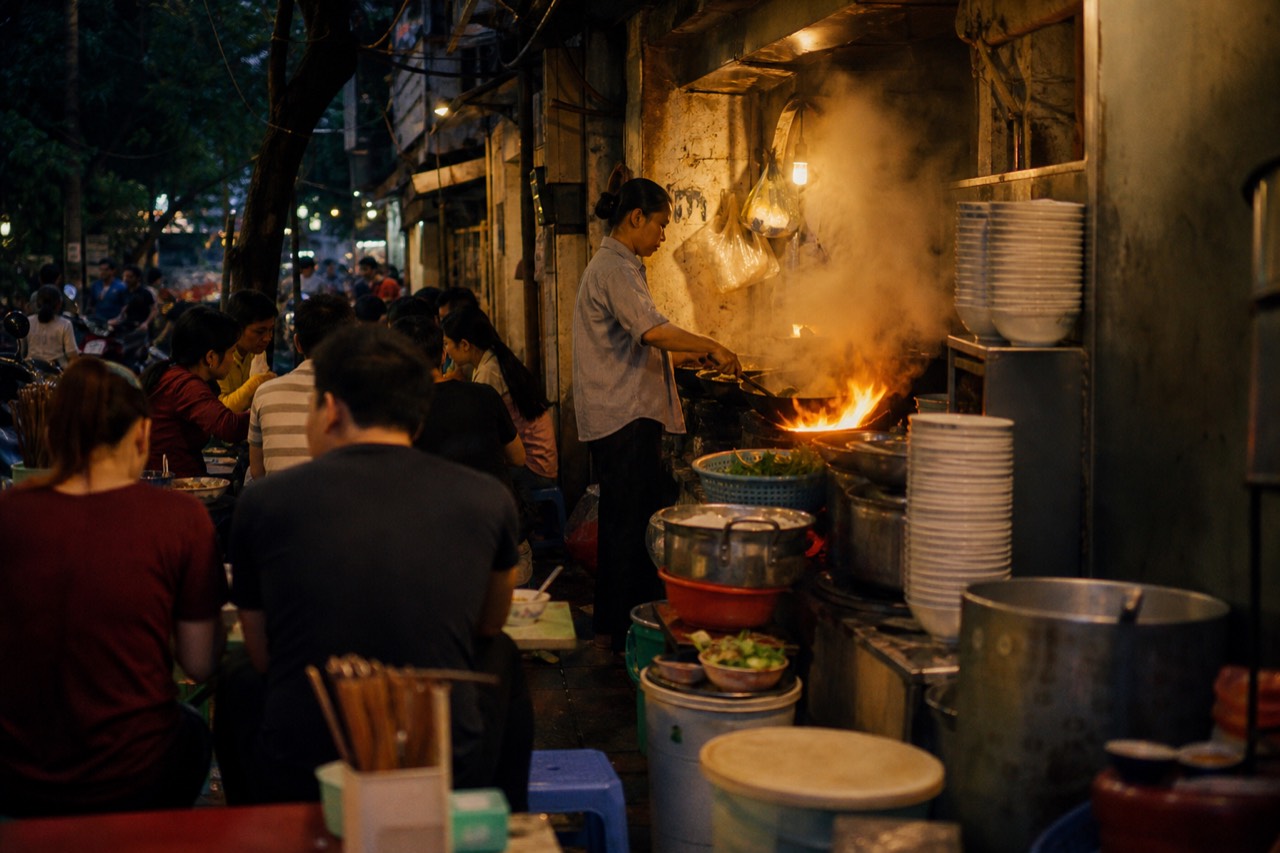
Around noon on Hang Manh, charcoal smoke from a single bun cha grill drifts halfway down the block, and office workers claim plastic stools before the lunch rush swallows them. Nothing about the setup has changed in decades. What has changed is the paperwork around it: 2026 brought Vietnam's first nationwide push to inspect street vendors, new food-safety decrees, and rising pork prices that stall owners are quietly absorbing rather than passing on.
Where is the best street food in Hanoi?
The Old Quarter is the densest street food zone in the city, with the benchmark shops packed into a few hundred metres: pho on Bat Dan, bun cha on Hang Manh, cha ca on Cha Ca Street, egg coffee on Nguyen Huu Huan, and bia hoi on Ta Hien. Almost everything worth queuing for sits within a 15-minute walk.
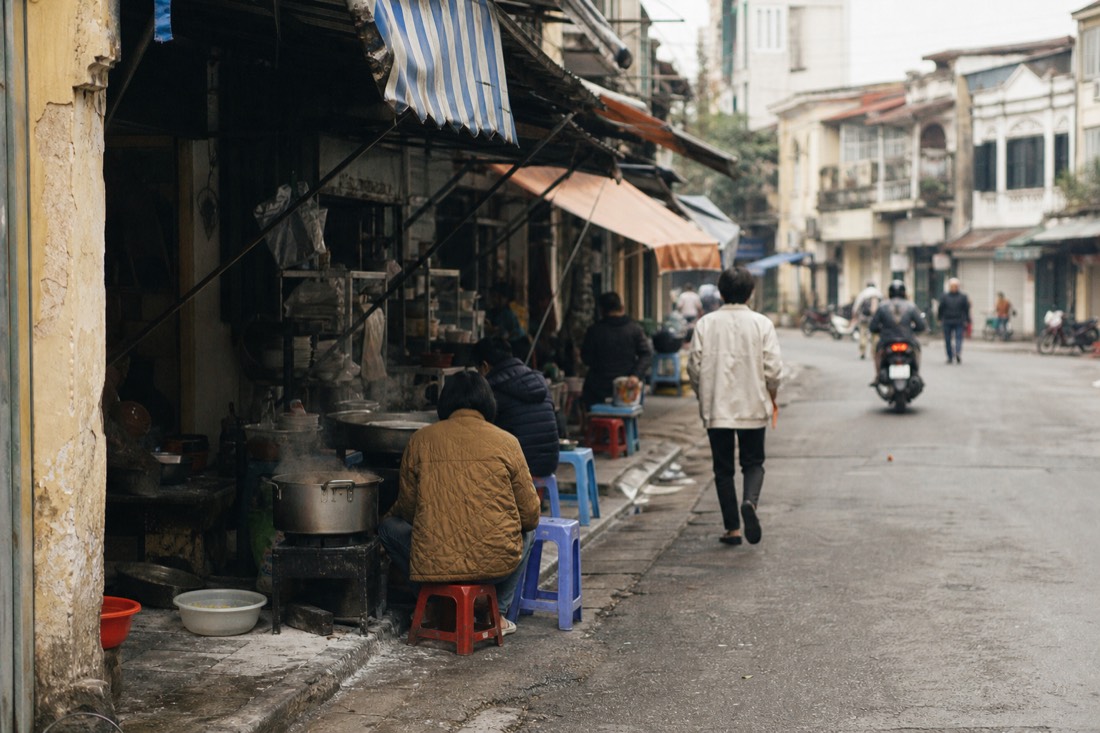
The pattern to understand is specialisation. A Hanoi street kitchen typically cooks one dish, has cooked it for a generation or two, and sells out inside a fixed window. Pho Gia Truyen at 49 Bat Dan serves 6 to 11 in the morning and 5 to 9 at night, then shuts. Bun Cha Dac Kim's grill at 1 Hang Manh runs 10:30 to 3. Turn up outside the window and you get a stacked chair, not a bowl.
That is why "best" in Hanoi means a list of addresses more than a neighbourhood ranking. The full dish-by-dish list, with prices, is in the what to eat in Hanoi guide; the geography below is the other half of the puzzle.
What are the famous food streets in Hanoi?
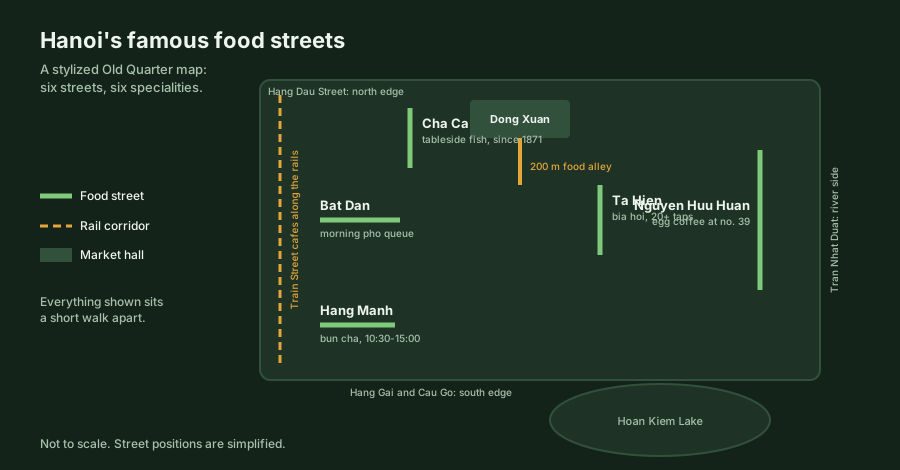
Six names do most of the work: Bat Dan for pho, Hang Manh for bun cha, Cha Ca Street for turmeric fish, Nguyen Huu Huan for egg coffee, Ta Hien for bia hoi, and the 200-metre food alley beside Dong Xuan Market. All six sit inside or on the edge of the Old Quarter.
| Street | Known for | Best time | Anchor address |
|---|---|---|---|
| Bat Dan | Beef pho, clear northern broth | 6 to 11 am | Pho Gia Truyen, no. 49 |
| Hang Manh | Bun cha off the charcoal | 10:30 am to 3 pm | Bun Cha Dac Kim, no. 1 |
| Cha Ca Street | Tableside turmeric fish since 1871 | Dinner | Cha Ca La Vong, no. 14 |
| Nguyen Huu Huan | Egg coffee, cafe row | Afternoon | Cafe Giang, no. 39 |
| Ta Hien | Bia hoi, the "beer street" | After dark | The whole 70-metre lane |
| Dong Xuan alley | Snail noodles, shrimp cakes, porridge | Daytime | Beside Dong Xuan Market |
Ta Hien is barely 70 metres long yet holds more than 20 open-air bia hoi serving points each night, the highest density of any lane in the city. The Dong Xuan alley squeezes hundreds of small food shops into 200 metres: crispy shrimp cakes, bamboo-skewer vermicelli, snail noodles, rib cartilage porridge. Both, plus the guild-street history around them, get full treatment in the Old Quarter food guide.
How much does street food cost in Hanoi?
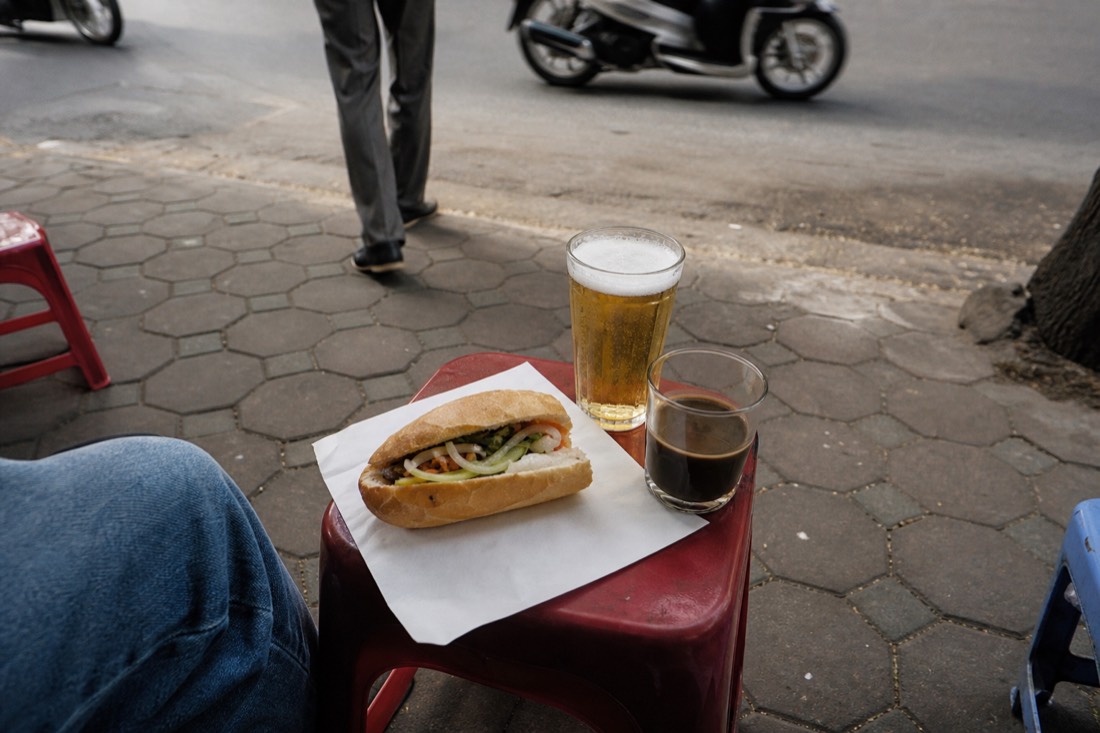
Almost every street dish in Hanoi costs 20,000 to 80,000 VND, meaning $0.80 to $3.20 at 2026 exchange rates of 25,000 to 26,000 VND per dollar. A full day of serious street eating, beer included, lands around 300,000 VND, or roughly $12.
| Order | 2026 street price (VND) | Approx. USD |
|---|---|---|
| Banh mi | 20,000 to 40,000 | $0.80 to $1.60 |
| Pho | 40,000 to 60,000 | $1.55 to $2.40 |
| Bun cha | 40,000 to 80,000 | $1.55 to $3.20 |
| Egg coffee | 30,000 to 45,000 | $1.15 to $1.80 |
| Bia hoi, per glass | 10,000 to 15,000 | $0.40 to $0.60 |
| Grilled pork noodles, typical serving | 30,000 to 40,000 | $1.15 to $1.60 |
Those prices are holding steady even though vendor costs are not. By spring 2026, Hoan Kiem vendors reported pork up from 130,000 to 160,000 VND a kilo and vegetables rising too, while keeping servings at 30,000 to 40,000 VND and watching daily foot traffic thin out. Translation for visitors: prices are honest, margins are thin, and haggling over food is poor form. Tipping is not expected either; rounding up or leaving small change is the local gesture.
Pay in cash, in small notes. A 500,000 VND bill at a 25,000 VND banh mi cart creates a small diplomatic incident.
Is street food in Hanoi safe to eat?
Broadly yes, if you follow the standard rules: hot, freshly cooked food from busy stalls; bottled or boiled water only; caution with ice and raw herbs. Vietnam also tightened enforcement in 2026, with nationwide inspections and fines for vendors using unsafe water or dirty utensils.
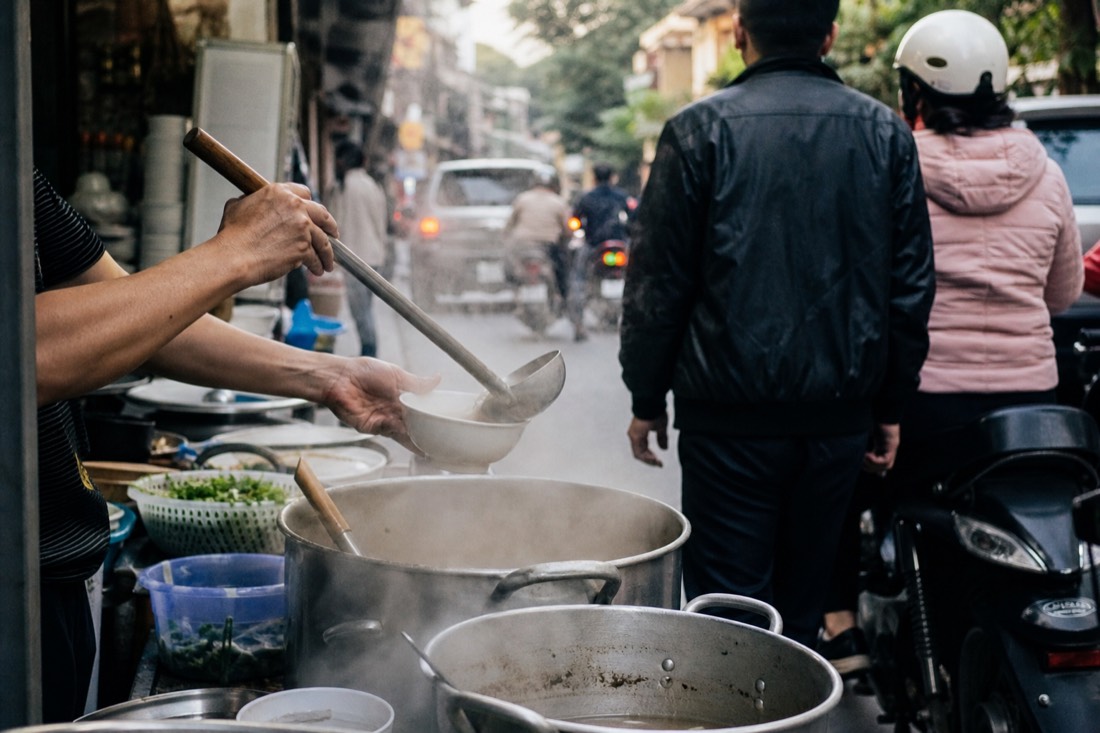
The CDC's guidance for Vietnam is the sensible baseline: skip tap water, be thoughtful about ice and raw garnishes, and favour food that comes to you hot from the flame. In practice, the queue is your best inspector. A stall turning over a hundred bowls a day never lets ingredients sit.
| Concern | Actual risk level | What to do |
|---|---|---|
| Tap water | High, avoid entirely | Bottled or boiled only, including for teeth brushing |
| Ice | Variable | Fine in busy cafes using factory ice; skip at quiet stalls |
| Raw herbs and salads | Moderate | Safer at high-turnover shops; easy to set aside if unsure |
| Hot cooked dishes | Low | The core of what you should eat; watch it leave the wok |
| Meat sitting unrefrigerated | High | Choose stalls grilling and boiling to order |
The regulatory backdrop moved fast this year, which is genuinely good news for eaters; the details are in the data box below.
What kinds of street food stalls are there in Hanoi?
Hanoi street food comes from five setups you learn to read at a glance: the single-dish shophouse, the pavement charcoal grill, the mobile cart or shoulder pole, the market-alley counter, and the bia hoi corner. Each keeps its own hours, sits differently under the 2026 rules, and asks something different of you.
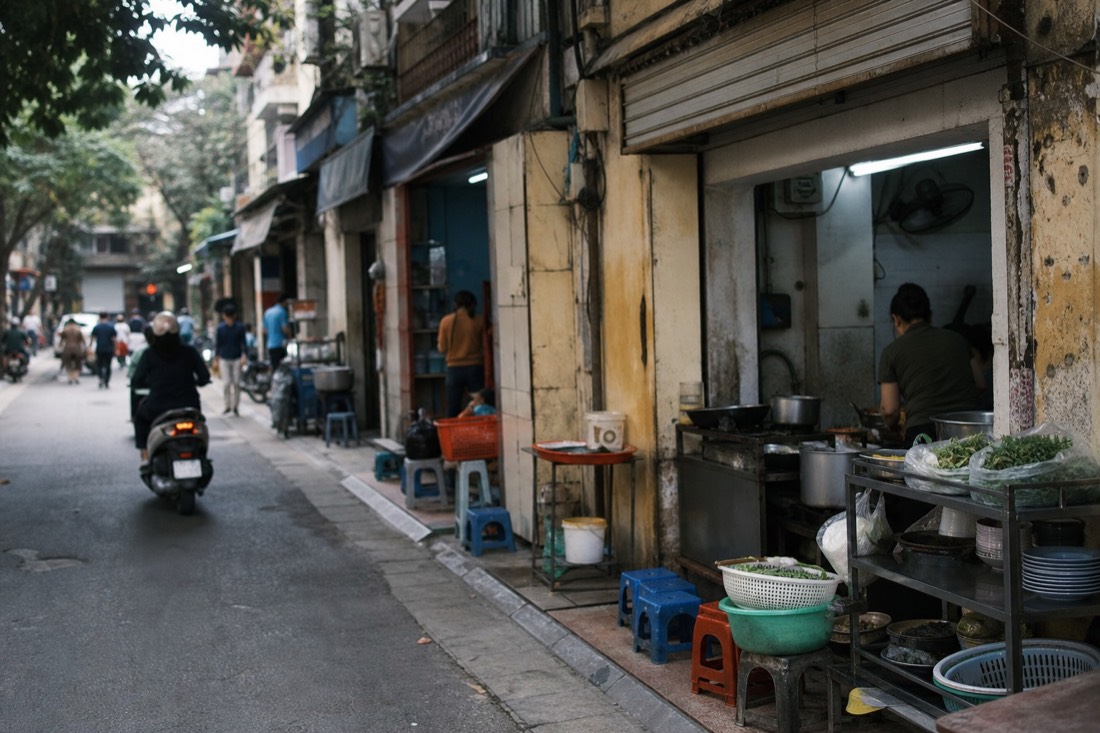
The single-dish shophouse is the one people travel for. It holds a ground floor, cooks one thing, and has usually done so under the same family for two or three generations. Pho Gia Truyen on Bat Dan and Bun Cha Dac Kim on Hang Manh both work this way, and both stop the moment the pot or the grill is finished.
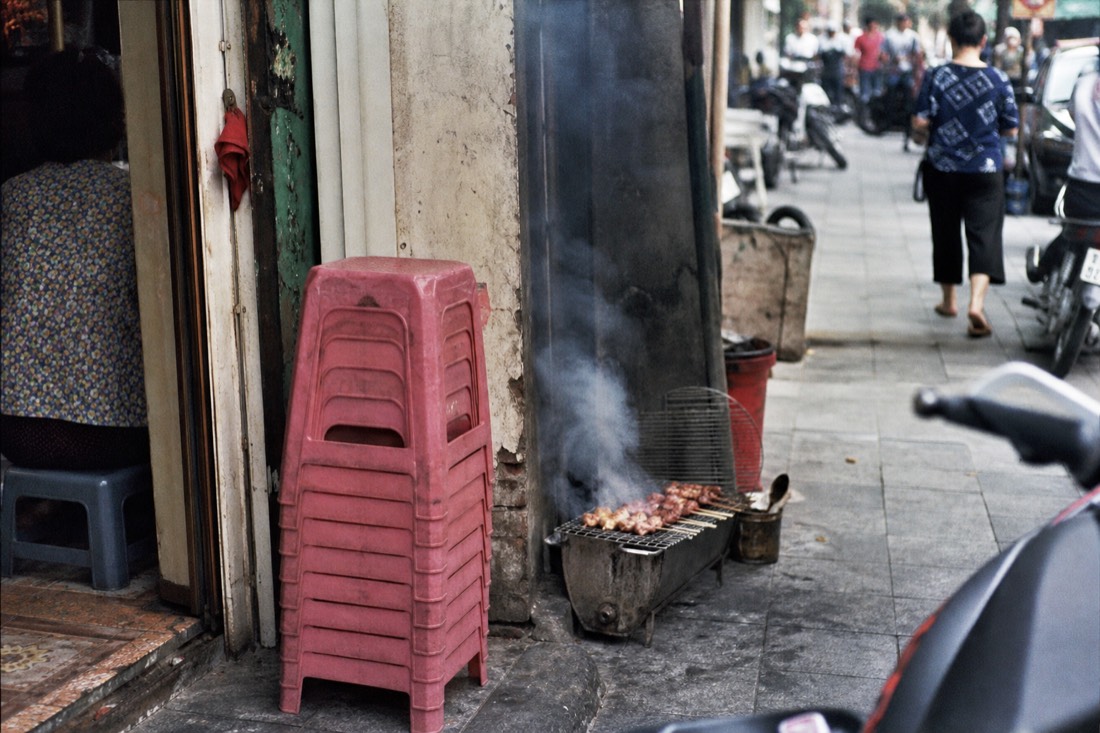
The pavement grill is a different animal. It belongs to a shopfront but lives on the kerb, appearing when the charcoal is lit and disappearing when it burns down. When someone drags a brazier and a stack of stools into the gap between two shops, that is a kitchen opening rather than a shop closing.
Mobile vendors carry the whole business with them: a shoulder pole with two baskets, or a bicycle rebuilt into a banh mi counter, moving through the quarter on office hours and school runs. This is also where the 2026 rules draw their sharpest line. Mobile vendors and household producers stay exempt from full licensing, while most fixed food businesses now need a formal safety certificate, and hygiene standards plus basic safety training apply to everyone regardless.
The last two setups are the ones visitors underuse. Market-alley counters, best seen beside Dong Xuan, sit shoulder to shoulder and still sell one thing each. The bia hoi corner is barely a stall at all: a keg, a stack of stools, and a lane that fills after dark.
| Setup | How it trades | Typical order | Where it sits in the 2026 licensing split |
|---|---|---|---|
| Single-dish shophouse | Fixed address, one dish, one narrow window | Pho, bun cha, cha ca | Fixed business, so the certificate requirement applies |
| Pavement charcoal grill | Belongs to a shopfront, spills onto the kerb at set hours | Grilled pork, skewers | Judged with the registered shop behind it |
| Mobile cart or shoulder pole | Moves through the quarter, no fixed pitch | Banh mi, sticky rice, fruit | Exempt from full licensing; hygiene and training still required |
| Market-alley counter | Fixed counter and stools beside a market | Snail noodles, shrimp cakes, porridge | Fixed pitch, so the certificate side of the split |
| Bia hoi corner | Kegs delivered daily, stools on the pavement, evenings only | Bia hoi at 10,000 to 15,000 VND a glass | Fixed pitch; the food it serves follows the same rules |
Reading the setup tells you the risk profile too. A high-turnover shophouse and a busy grill are the safest things you will eat all week, while anything sitting unheated in a tray is the one category to walk past, a point the street food safety guide works through in more detail.
What time of day is each Hanoi street dish sold?
Hanoi sells its dishes in narrow windows, not all day. Rice-noodle breakfasts run from dawn to about 11, bun cha grills stop around 3, fryers and sweet counters own the afternoon, a second pho window opens at 5, and beer corners take the night. Arrive outside the window and the shop is simply shut.
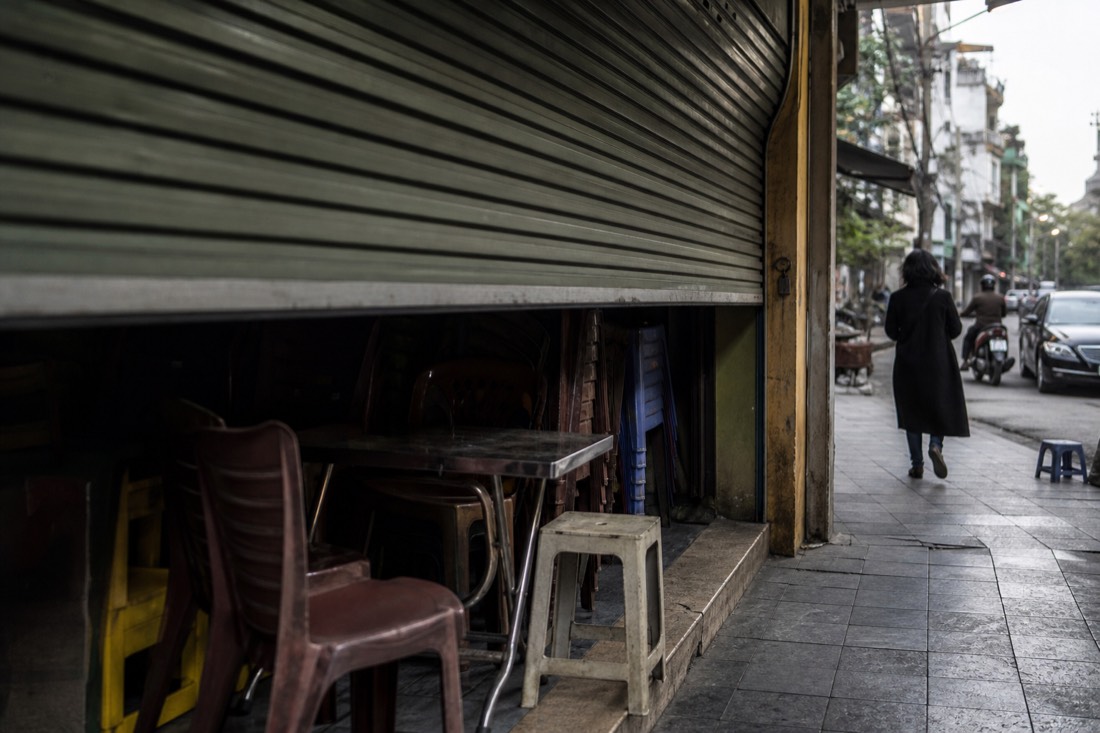
This is the single most expensive thing to get wrong. A visitor who lands at 4 pm and goes looking for the famous bun cha will find a closed grill and a stacked chair, then conclude that Hanoi's reputation is overstated. The city is not overstated. It is scheduled.
The rhythm follows how Hanoians actually eat. Breakfast is a proper cooked meal taken early and fast, which is why pho and banh cuon are morning food and start losing quality by mid-morning. Lunch is short and hot. The gap between 3 and 5 is genuinely thin, filled by fryers, sweet counters and coffee rather than full dishes. Then the evening arrives in two layers: a second serving window at the noodle shops, and the pavement drinking economy on top of it.
| Time block | What is being sold | Where to be |
|---|---|---|
| 6 to 11 am | Beef pho, banh cuon, morning noodles | Bat Dan, breakfast shops across the Old Quarter |
| 10:30 am to 3 pm | Bun cha off the charcoal, rice-plate lunches | Hang Manh and the lunch grills around it |
| 3 to 5 pm | Fried snacks, che, egg coffee, market grazing | Nguyen Huu Huan cafe row, the Dong Xuan alley |
| 5 to 9 pm | Second pho window, cha ca dinner service | Bat Dan, Cha Ca Street |
| After dark | Bia hoi, grilled skewers, late noodle pots | Ta Hien and the lanes around it |
| Friday 7 pm to Sunday night | All of the above, plus stalls in the roadway | The pedestrian zone around Hoan Kiem Lake |
Two windows are worth building a day around: get to Bat Dan before 8 am while the broth is at its freshest, and treat 11 to 1 as the only sensible bun cha slot. A full day built on those hinges is laid out in the Hanoi food itinerary.
How do you order street food in Hanoi without speaking Vietnamese?
Point, hold up fingers, sit down, and pay in small notes at the end. Most shops sell one dish, so ordering is a question of how many rather than what. Prices are fixed rather than negotiable, so haggling over food only creates friction, and no tip is expected.
Sitting down is usually the order. At a single-dish shop, taking a stool signals one serving per person, and the bowl arrives without a word passing. Where there is a choice, the fastest method is to look at the table beside you and point. Nobody minds. Half of Hanoi orders that way when they walk into an unfamiliar shop.
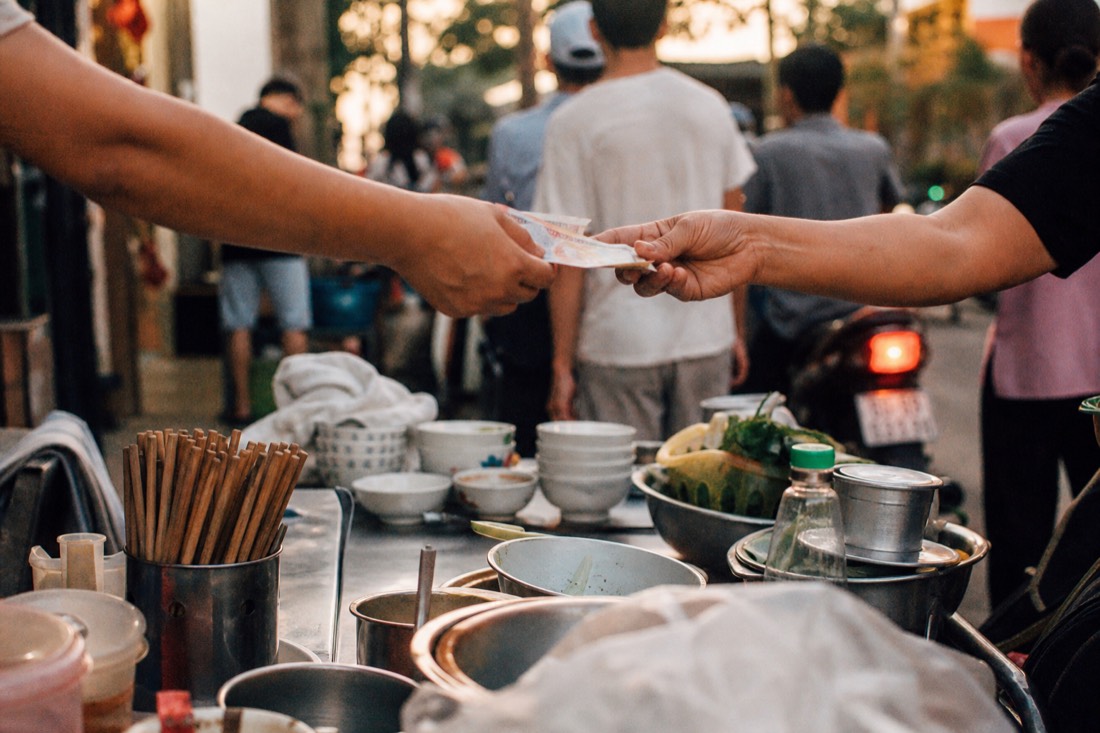
Cash is the other half of the skill. Street prices sit between 10,000 and 90,000 VND, so the useful notes are the 10,000, 20,000 and 50,000, and a 500,000 note at a banh mi cart is a small diplomatic incident. At 25,000 to 26,000 VND per dollar, a 100,000 note is roughly four dollars, which covers two people at most stalls. Card readers exist in cafes and almost nowhere on the pavement. What things actually cost, dish by dish, is tracked in the Hanoi food price guide.
| Phrase | What it means | When it earns its keep |
|---|---|---|
| Cho tôi | Give me, I would like | Opening any order |
| Một, hai, ba | One, two, three | Quantities, though fingers work just as well |
| Bao nhiêu tiền? | How much? | Carts and stalls with no posted price |
| Không cay | Not spicy | Chilli-heavy dips, especially bun cha broth |
| Ăn chay | Eating vegetarian | Meat stock is the default, so say it early |
| Cảm ơn | Thank you | Leaving, always |
One caution on the vegetarian phrase: it flags intent, but northern broths and dipping sauces lean on pork and fish sauce, so the safer route is choosing dishes that were never built on meat stock in the first place. The vegetarian and gluten-free guide lists which ones survive that test.
What should a first-timer in Hanoi eat first?
Bun cha, not pho. I start visitors on charcoal-grilled pork because it reads instantly to anyone, whatever they eat at home, and the lunch window is easy to hit on a first full day. Pho comes the next morning, when jet lag already has you awake at six and the queue on Bat Dan is at its best.
I am Mai Trần, and I have guided food walks in this city since 2015, well past a thousand travellers by now. The pattern I see is that people arrive determined to eat pho immediately, usually at the wrong hour, in the wrong state, after a long flight. Pho is a quiet dish. It rewards an early morning and an empty stomach, and it punishes a tired palate expecting a big flavour hit.
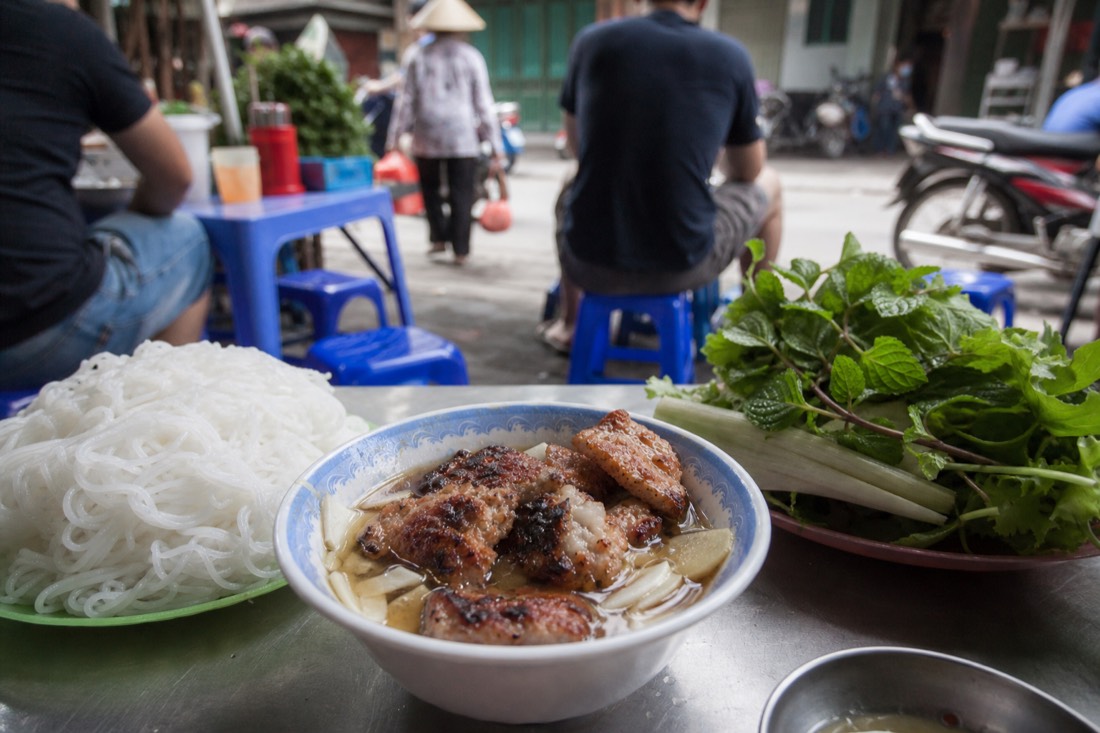
Bun cha does the opposite. Smoke, fat, herbs, sweet and sour broth, all obvious at first bite. It also introduces the mechanic that makes northern eating make sense: you assemble the mouthful yourself, pulling noodles and herbs through a dipping bowl rather than receiving a finished plate.
My other rule is pacing. Most first-timers eat one dish, feel full, and lose the rest of the evening. The trick is to share early and keep walking between stops, so appetite has time to come back. My hygiene habits have not changed in a decade of doing this: the busiest stall on the street, food hot off the flame, bottled water only, and I set raw herbs aside at any quiet counter.
These are planning allowances I use when pacing a night of eating, not published figures.
| Stop | What I order | Portions for two | Gap before the next stop |
|---|---|---|---|
| Opening dish | Bun cha off the charcoal | One set shared | 20 to 30 minutes on foot |
| Something fried | Banh goi or a skewer | Two pieces, split | 15 minutes |
| A proper bowl | Pho or noodles | One bowl each if you skipped lunch | 20 minutes |
| Something sweet | Che | One cup each | 10 minutes |
| Last stop | Bia hoi | One glass at a time | The rest of the night |
Guests tell me the guided walks work for the same reason: someone else decides the order and the gaps. If you would rather build it yourself, the sequence above is the skeleton, and the 36 guild streets, address by address supply what you hang on it.
Should you eat with a guide or on your own?
Do both. Solo eating works well for the famous single-dish shops, where the address and the serving window are the whole secret. A guided evening earns its cost at the anonymous-looking stalls, the ordering rituals, and the dishes you would never identify from the pavement.
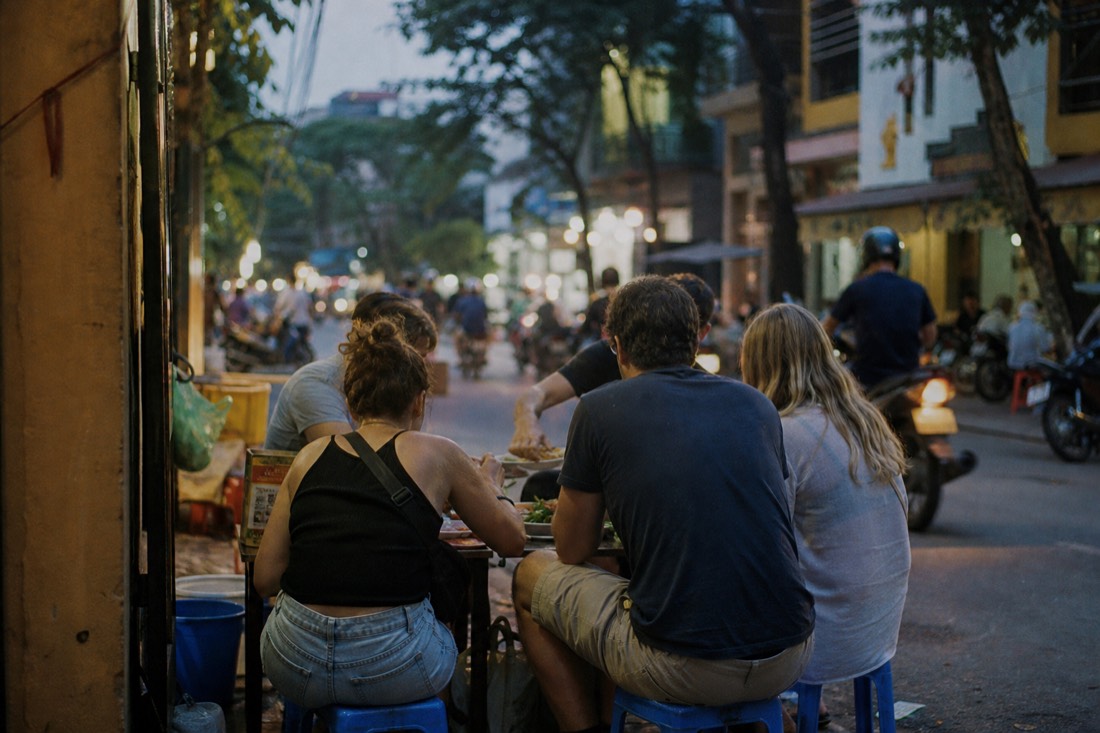
Good alternatives exist at both ends of the energy scale. The Real Foodie small-group tour runs a tight three hours with a maximum of eight guests and a perfect 5.0 across 5,202 Viator reviews. If sitting on the back of a vintage Minsk while someone else worries about traffic sounds better than walking, the motorbike food tour options cover more ground and more neighbourhoods in an evening. The honest breakdown of when a tour beats solo wandering is in the DIY versus guided comparison.
Is street food in Hanoi safe for tourists?
Generally yes. Choose busy stalls serving hot, freshly cooked food, drink only bottled or boiled water, and be careful with ice and raw herbs. Vietnam stepped up vendor inspections nationwide in 2026, with fines for hygiene violations. Most visitors eat street food daily without trouble; stomach issues usually trace to water, ice or food left sitting, not to the cooking itself.How much should I budget per day for street food in Hanoi?
Around 300,000 VND, roughly $12, covers a full day: pho breakfast at 40,000 to 60,000, a banh mi snack at 20,000 to 40,000, bun cha lunch at 40,000 to 80,000, egg coffee at 30,000 to 45,000, dinner, and several 10,000 to 15,000 glasses of bia hoi. Double it and you are feasting.Which street in Hanoi is famous for beer?
Ta Hien, in the heart of the Old Quarter. The lane runs about 70 metres and packs in more than 20 open-air bia hoi serving points nightly, the highest concentration in Hanoi. Fresh draft beer costs 10,000 to 15,000 VND a glass, brewed for same-day drinking, and the street gets loud after dark.What time do Hanoi street food stalls open and close?
Each shop keeps its own narrow window. Pho and banh cuon are morning dishes; the benchmark pho shop on Bat Dan serves 6 to 11 am, then again 5 to 9 pm. Bun cha runs lunch only, roughly 10:30 to 3. Snack fryers work the afternoon, and bia hoi corners pour from the early evening until late.Your next Hanoi experience
Check your date before planning the rest of the day
Small-group Hanoi food walk
Taste a changing selection of Hanoi dishes with a local guide in a group of up to eight.
Old Quarter pickup; otherwise 41 Luong Van Can. Food tastings and a drink included. Menu varies; dietary requests need advance confirmation.
An editorial starting point. Confirm your party’s requirements with the operator.
Choose a date to see scheduled departures. Final availability and price are confirmed on Viator.
No verified option fits those requirements. Adjust your choices or reset to explore the general recommendations.
Compare options, fit your schedule & check your budget
Small-group Hanoi food walk · 3h. Taste a changing selection of Hanoi dishes with a local guide in a group of up to eight. Old Quarter pickup; otherwise 41 Luong Van Can. Food tastings and a drink included. Menu varies; dietary requests need advance confirmation.
Private Old Quarter food walk · 3h. Explore the Old Quarter with a guide dedicated to your own party. Old Quarter pickup or 38 Bat Su. Tastings included. Confirm specific dietary and access needs before booking.